
Product Information — know more, sell more…
Kit Heath brand information to help you and your team:
- Each piece of our jewellery comes with a luxurious presentation box and care guide, optional gift bag, gift tag with branded tissue paper. Consumer brochures available on request – see page 148.
- Our designs are 925 sterling silver, stamped 925 and KH size permitting.
- Designs are shown at actual size unless otherwise stated.
- Designs in the quick reference guide highlighted with an
 are rhodium-plated sterling silver.
 - Rhodium-plate is tarnish and scratch-resistant.
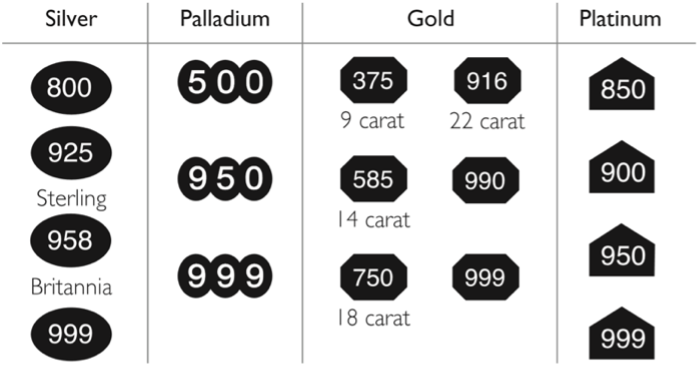
- Pieces over the silver weight of 7.7g will be hallmarked by the Edinburgh Assay Office.
- Our rose and yellow gold is 18ct plate and recommended for occasional wear.
- Designs in the quick reference guide highlighted with an
 are suitable for engraving.
Our engraving service is available free of charge. - All standard necklaces are on an 18" chain including a 2" shortener unless otherwise stated. Chain extenders are available.
- Our semi-precious gemstones are a variety of natural quartz and minerals — variations in size, colour and inclusions should be expected.
- All designs are © copyright to Kit Heath Ltd.
- Orders available pre-boxed on request, please enquire regarding this add-on service.
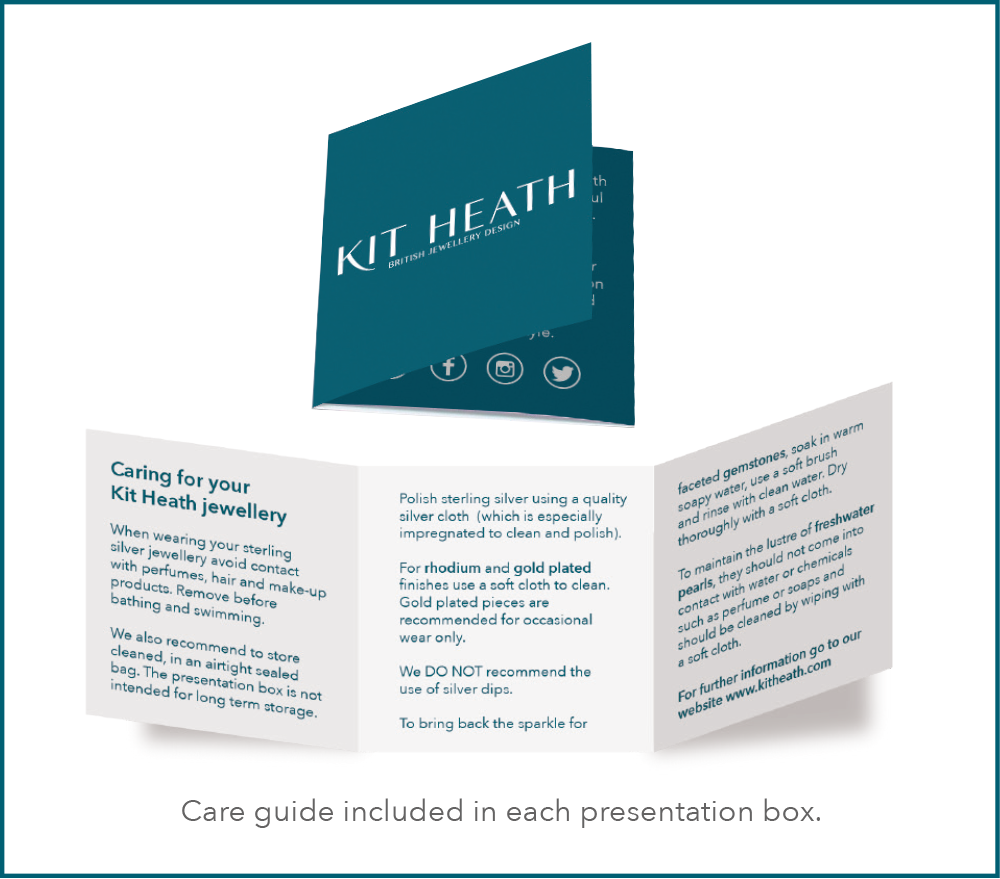
Caring For Your Kit Heath Jewellery
To keep your Kit Heath sterling silver looking beautiful, we recommend you care for it in the following ways:- When wearing your sterling silver jewellery avoid contact with perfumes, hair and make-up products. Remove before bathing and swimming.
- We also recommend storing jewellery cleaned, in an airtight sealed bag. The presentation box is not intended for long term storage. Polish sterling silver using a quality silver cloth (which is specially impregnated to clean and polish).
- For rhodium and gold plated finishes use a soft cloth to clean. Gold plated pieces are recommended for occasional wear only.
- We DO NOT recommend the use of silver dips.
- To bring back the sparkle of faceted gemstones, soak in warm soapy water, use a soft brush and rinse with clean water. Dry thoroughly with a soft cloth.
Kit Heath Ltd Gold Plate Factsheet

- All jewellery designs are 925 sterling silver.
- All gold plate used is real 18ct gold.
The Céleste collection, as an exception, is flash gold plated to maintain its collection price banding.

- All items are 925 sterling silver.
- All gold plate used is real gold in either 9ct, 14ct or 18ct.
- All gold plating is a flash plate.
Only designs of higher gold fineness standards will be marketed as such.
Gold Plating Standards
| Flash Plating | Gold Plating | Vermeil (ver-may) | |
| Base | Any metal alloy | Any metal alloy | Sterling silver |
| Thickness | ≥0.175μm (micron) | ≥1μm | ≥2.5μm |
| Fineness | 9ct | 14ct | 18ct | 9ct | 14ct | 18ct | 14ct | 18ct |
| Price | £ | ££ | £££ |
Testing
We regularly test pieces from each range and supplier to ensure that all jewellery complies with these standards and legislations.
FAQ: All About Gold Plate
What is Gold Plate?
Gold plate/plating is used to describe the covering of an item with a fine layer of gold. The plating can be full coverage over a base metal or sterling silver alloy or partial details to provide contrast in a two- or three-tone design.
Is Gold Plate “Real Gold”?
Yes. The same standards apply to real “solid” gold and the gold used for plating jewellery.
In the UK, to use gold plate/gold plating in describing an item of jewellery, the gold fineness must be at least 375 parts per thousand, i.e., a minimum standard of 9ct gold.
Additionally, when the word “gold” is used to describe a gold-plated silver piece of jewellery, it must be described as silver in the first instance, with the word “gold” immediately followed by “plated” (or permitted term), e.g., “18ct gold plated/bonded/clad silver ring”.
NB. The plating on an item does not qualify for any Hallmark to signify its quality so any item will be hallmarked as the main alloy underneath the plating.
What is the difference between 9ct, 14ct and 18ct gold?
The “carat” is the fineness of gold and refers to the proportion of gold used in the alloy. These proportions are measured in parts per thousand (ppt). The other metals used to make up the 1000 parts can be any mix of other precious or base metals, and their combination is what is referred to as an alloy.
The lowest standard gold legally recognised in the UK is 9ct. It must contain at least 375 parts gold. The lowest standard recognised in the US is 10ct (or “10K” as it’s known in the US.)
14ct contains at least 585ppt gold.
18ct gold must be at least 750ppt gold.
Other metals constituting the alloy do not have to be precious metals. The metals in the alloy can affect the colour appearance of the gold, e.g., more copper for a rose gold alloy and more silver for a whiter gold alloy.
Both 14ct and 18ct are widely recognised standards internationally.
What about 10K gold?
10 carat (10ct, or 10K) gold is an internationally used fineness of gold that is not legally recognised in the UK. 10ct gold is 417 parts gold to a thousand. Because it falls under the required fineness for 14ct gold, this would become classified as 9ct gold in the UK.
Caring for Gold Plated Jewellery
Like any delicates, wear all jewellery with care—last on, first off. Always remove any jewellery before high-impact activities, e.g., housework, swimming, or showering.
All gold plated pieces are recommended for occasional wear only to maintain the plating finish.
Always clean with a soft, non-abrasive cloth.
Do not use chemical jewellery dips—they can cause permanent damage to your jewellery, and remove the plating.
What is Flash Plating?
The term “flash plating” describes items plated with a fine layer of gold, usually under 1 micron but at least 0.175 microns in thickness.
Is “gold plate” different from “flash plate”?
Both are legally classed as “gold plating”. Flash plating is generally thinner and not as long-lasting in wear and is recommended for occasional wear only.
Gold plating over 1 micron in thickness is not referred to as flash plating.
So, what is gold vermeil?
Vermeil (pronounced ver-may) originates in 19th century France and is a term that has come to mean a premium “gilding” standard and can only be used to describe gold plated items that are—
- made in sterling silver,
- gold plated with a minimum 14ct fineness (10K minimum in the US), and
- the gold plating is a minimum of 2.5 microns in thickness.
How Long Does Gold Plate Last?
All gold plate will eventually wear off in use. The thicker the plating, the longer it will last, but ensuring care is taken, the plating can last indefinitely.
